
Professional Surface Impact Assessment

Professional GMAX Safety Testing and Reporting

Protect athletes, assess playing-surface performance, and receive practical recommendations supported by clear, date-stamped field data.

Assessment
Coordinated on-site assessment
Testing
Testing and reporting process
Reporting
Documented report for each approved scope

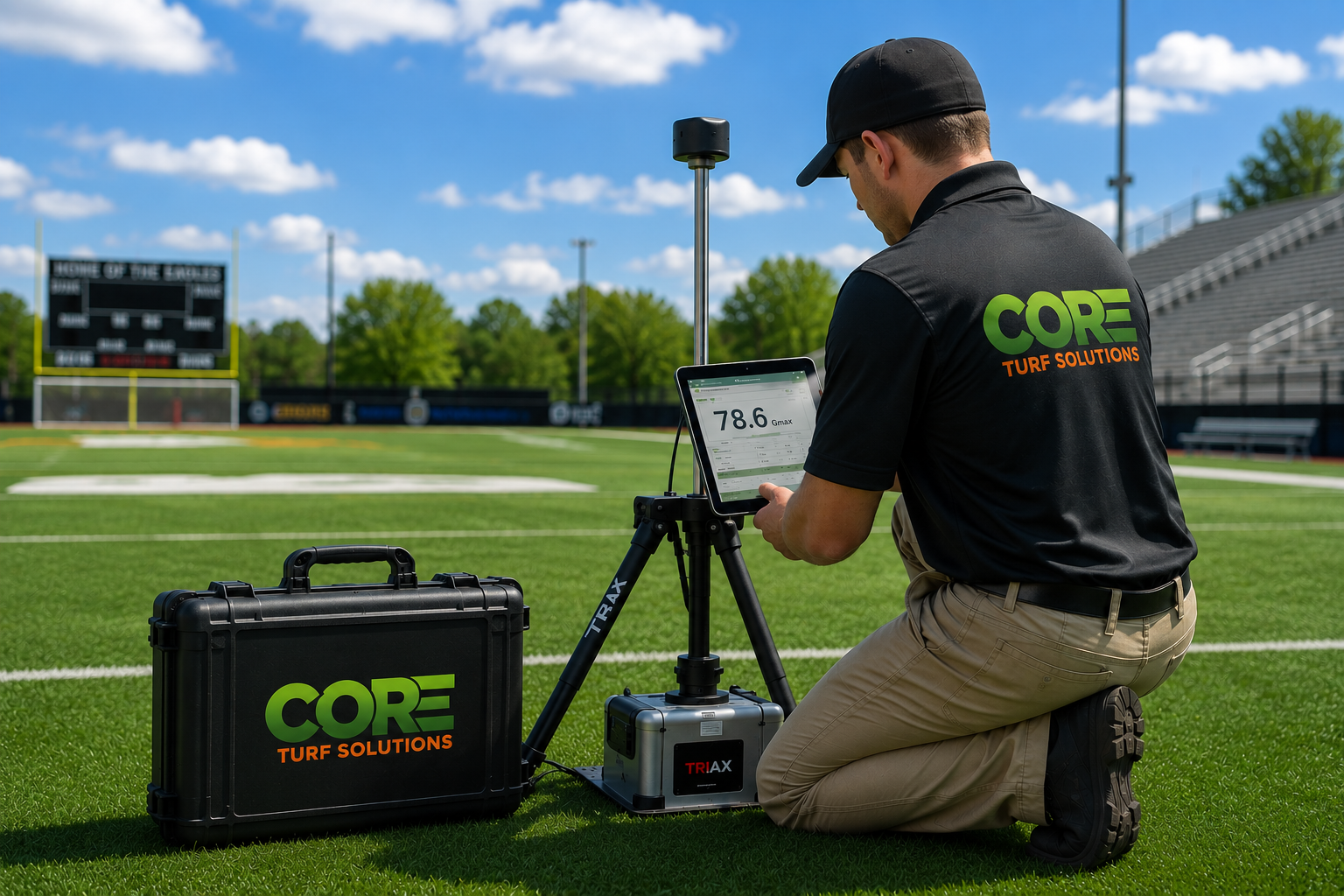
Core Turf Solutions technician conducting GMAX impact testing on an athletic field

Objective Field Data
Measurements, observations, dates, locations, and practical recommendations.

“`

Trained Field Technicians
Calibrated Testing Equipment
Documented Testing Methods
Transparent Project Scope
Responsive Scheduling

Testing and Reporting Services

GMAX Testing That Supports Better Field Decisions

Core Turf Solutions evaluates sports surfaces and playground surfaces for impact attenuation, helping owners connect objective measurements with athlete safety, fall protection, and field performance decisions.

This surface impact attenuation assessment helps identify how effectively a playing surface reduces force during falls or other impacts, supporting informed maintenance, safety, and risk-management decisions.

01

Professional Field Testing

Technicians measure G-max values at representative locations across artificial turf, natural turf, or another impact-attenuating playing surface.

02

Synthetic Turf Assessment

Testing can help evaluate how infill distribution, compaction, wear, and surface conditions affect impact attenuation and maintenance priorities.

03

Detailed Reports

GMAX reporting documents test locations, readings, field conditions, observations, testing dates, and relevant limitations.

04

Safety Concern Identification

Results can reveal inconsistent, compacted, worn, or unusually firm areas that warrant further field safety review.

05

Maintenance Planning

Findings can inform grooming, decompaction, infill redistribution, infill addition, repair, monitoring, and follow-up testing priorities.

06

Performance Documentation

Historical field documentation helps owners compare conditions across testing cycles instead of relying on visual inspections alone.

“`

Specialized Impact Assessment

Testing Procedures Matched to the Surface and Scope

When applicable to the surface and selected standard, the approved scope may address Head Injury Criterion, commonly abbreviated as HIC.

Testing requirements vary by surface, intended use, manufacturer instructions, site concerns, and the applicable procedure. Core Turf Solutions defines these variables before testing so the resulting data answers the facility’s actual maintenance and risk-management questions.

A Defined Scope May Consider


Surface type, age, construction, and intended use

Field-use patterns and recently completed maintenance

Selected procedure, test locations, and reporting detail

Calibration requirements and equipment selection

Applicable manufacturer or industry guidance

“`

Defensible Field Records

Documentation That Supports Better Decisions

A date-stamped report establishes a documented record of surface compaction, measured conditions, and observed deficiencies at the time of testing. Historical tracking can then show whether maintenance improved performance or whether conditions continued to change.

Condition and Measurement Records

When included in the approved scope, the report can record the Motz365 Condition as a named field or condition indicator, with supporting measurements and site observations for clear interpretation.

Readings should be considered together with the test location, surface condition, date, maintenance history, selected procedure, equipment, and stated limitations.

Support for Facility Stakeholders

Organized documentation can support manufacturer recommendations, warranty requirements, capital budgeting, maintenance records, and communication among administrators, operations teams, coaches, insurers, and other stakeholders. It gives decision-makers a practical basis for prioritizing limited maintenance funds.

Field-Focused Service

Why Choose Core Turf Solutions?

Receive clear information that connects technical testing with practical field management decisions.

1

Field-Focused Expertise

Testing addresses the real safety concerns and maintenance decisions faced by facility teams.

2

Clear Reporting

Results are organized so technical readings remain understandable to operational and administrative stakeholders.

3

Actionable Recommendations

Each approved scope connects measurements with practical maintenance, monitoring, or follow-up priorities.

4

Appropriate Procedures

Technicians select documented methods according to the surface, intended use, approved scope, and relevant standards.

5

Proactive Planning

Routine assessments can identify performance changes before they develop into larger repair or replacement concerns.

6

Transparent Scope

The proposed locations, procedure, reporting requirements, travel, and deliverables are reviewed before field work begins.

Request a GMAX Testing Quote

Tell us about your surface, location, approximate age, concerns, and preferred testing window.

Results You Can Document

Clear Measurements With Supporting Context

Core Turf Solutions avoids unexplained pass-or-fail statements. Reports provide supporting measurements, locations, conditions, observations, and relevant context so facility teams understand what was measured.

Calibrated equipment appropriate for the approved testing scope.

Consistent recording of locations, readings, dates, field conditions, and observations.

Transparent scope with upfront quote details and defined reporting deliverables.

Practical recommendations based on documented surface conditions and approved services.

Historical records for comparing readings and conditions across successive testing cycles.

Equipment selection that may include a TRIAX Touch, Triax 2015, Triax 2000, or another appropriate impact-testing device.

Instrument confirmation before field work based on the surface, procedure, calibration requirements, and reporting needs.

A Coordinated Process

How GMAX Field Testing Works

The process establishes expectations before site work begins, reducing scheduling uncertainty and preventing gaps in the final report.

01

Define the Scope

Review the surface type, age, intended use, recent maintenance, concerns, and reporting requirements.

02

Schedule the Visit

Coordinate testing around events, field availability, weather, travel, and planned maintenance windows.

03

Test Planned Locations

Conduct impact testing at representative points using the applicable procedure, which may involve an A Missile System.

04

Prepare the Report

Present readings, test locations, field observations, relevant limitations, and identified areas of concern.

05

Review Next Steps

Receive priorities for grooming, infill work, repairs, monitoring, maintenance, or follow-up testing.

Scheduled On-Site Testing

Flexible On-Site Service Coverage

Core Turf Solutions serves school districts, municipal parks, private clubs, colleges, playground operators, and sports complexes through scheduled on-site testing.

Facilities in Forest Park, St. Louis, surrounding communities, and Metro East communities can request scheduled GMAX testing for athletic fields, playground surfaces, and other impact-attenuating areas.

Availability depends on site access, field use, travel requirements, weather, and the number of test locations. Quote and report timelines are confirmed after the scope is reviewed.

Information to Include With Your Request

  • Facility and field location
  • Surface type and approximate age
  • Number and size of fields or surface areas
  • Recent maintenance or repair history
  • Known concerns or unusually firm areas
  • Preferred testing and reporting timeframe

GMAX Testing Information

Frequently Asked Questions

These answers explain common testing, scope, pricing, reporting, maintenance, scheduling, and provider-selection considerations.

1. What does GMAX safety testing and reporting include?
A typical engagement includes reviewing applicable requirements, testing planned surface locations, documenting measurements and field conditions, and preparing a report with observations and recommendations. The precise scope depends on the site, surface type, testing procedure, and reporting needs.
2. How much does GMAX testing cost?
Pricing depends on the site size, number of fields, planned test locations, travel, applicable procedure, required analysis, and reporting detail. Core Turf Solutions confirms the scope and deliverables before issuing a quote.
3. How long does the GMAX testing process take?
Field time varies with the surface area, number of planned locations, site access, field availability, and conditions on the testing date. Scheduling and expected report delivery are established during the proposal process.
4. How should I choose a GMAX testing provider?
Choose a provider that uses trained technicians, documented procedures, properly maintained or calibrated equipment, and clear reporting suitable for facility records. Confirm the scope, report format, turnaround expectations, and availability of follow-up consultation before approving the work.
5. Does a passing GMAX result eliminate future maintenance?
No. A single test does not replace routine inspection and maintenance because use, weather, infill movement, contamination, and compaction can change field performance. Periodic testing provides comparative information for determining when corrective work or closer monitoring may be appropriate.
6. What is GMAX testing?
GMAX testing is a form of surface impact testing used to measure how a playing surface responds when subjected to a controlled impact. The resulting measurement helps describe the relative hardness or impact attenuation of the tested surface at that location and time.
7. What does GMAX stand for?
GMAX generally refers to the maximum acceleration measured during a controlled impact, expressed relative to gravitational acceleration. The reading is interpreted according to the selected procedure, surface type, test conditions, and applicable requirements.
8. Why is GMAX testing important for athletic fields?
Testing provides objective information about impact response that cannot be determined reliably through appearance alone. It helps facility managers identify changes in surface firmness, compare conditions over time, and prioritize maintenance or additional evaluation.
9. What types of surfaces can be evaluated?
Depending on the approved scope and procedure, testing may be performed on synthetic turf, natural turf, playground surfacing, and other impact-attenuating surfaces. The surface construction and intended use must be reviewed before the testing method is selected.
10. Can GMAX testing be performed on synthetic turf?
Yes. Synthetic turf is commonly evaluated because infill depth, compaction, displacement, contamination, fiber wear, base conditions, and maintenance practices can affect impact response across the field.
11. Can natural grass fields be impact tested?
Natural turf can be evaluated when the selected equipment and procedure are appropriate for the surface and the facility’s goals. Soil moisture, compaction, turf density, wear, weather, and maintenance may influence the measurements.
12. Can playground surfaces be tested?
Playground impact-attenuating surfaces may be evaluated using procedures and equipment appropriate for playground fall protection. The scope should identify the surface system, equipment fall heights, applicable requirements, and desired reporting detail.
13. How often should an athletic field receive GMAX testing?
The appropriate frequency depends on field use, surface age, maintenance history, manufacturer recommendations, warranty requirements, prior readings, governing policies, and observed changes. Some facilities establish recurring testing intervals to create a consistent historical record.
14. Should a new synthetic turf field be tested?
Testing a new field can provide baseline measurements for future comparison and may help document initial conditions. Whether it is required depends on the contract, manufacturer, owner specifications, warranty terms, and applicable standards.
15. Should a field be tested after maintenance or repair?
Follow-up testing may help document whether grooming, decompaction, infill redistribution, infill addition, repairs, or other corrective work changed measured conditions. The timing should be coordinated with the completed maintenance and the facility’s reporting goals.
16. How are GMAX test locations selected?
Locations are selected according to the approved procedure, field layout, sport-use patterns, known wear areas, owner concerns, and required sampling plan. Representative testing helps identify differences that may exist across the surface.
17. Which areas of a synthetic turf field commonly receive greater wear?
Wear patterns vary by sport, but frequently used areas may include goal mouths, sidelines, midfield zones, team areas, penalty areas, faceoff locations, hash marks, and entrances. Testing plans should reflect the actual field configuration and use.
18. Does infill depth affect synthetic turf impact performance?
Infill depth and distribution can influence how a synthetic turf system responds to impact. Low, displaced, uneven, contaminated, or compacted infill may contribute to inconsistent surface conditions and should be considered alongside testing results.
19. Can grooming or decompaction improve field conditions?
Appropriate grooming or decompaction may improve infill distribution and reduce compaction in some situations. The correct maintenance method depends on the turf system, manufacturer guidance, infill condition, equipment, and documented field observations.
20. Can adding infill improve a synthetic turf field?
Adding compatible infill may be appropriate when documented depth or distribution is insufficient. The facility should confirm the correct infill type, quantity, placement, integration, and manufacturer requirements before completing the work.
21. What is included in a GMAX testing report?
A report may include the facility information, surface description, testing date, equipment, procedure, test-location identification, measurements, site observations, weather or field conditions, limitations, photographs when included, and practical recommendations.
22. Will the report identify each testing location?
The approved report can identify planned test locations using a map, diagram, location names, coordinates, photographs, or another clear method. Accurate location records make future comparisons more useful.
23. Will the report include maintenance recommendations?
When included in the scope, the report may recommend priorities such as additional inspection, grooming, decompaction, infill redistribution, infill addition, localized repair, monitoring, or follow-up testing. Recommendations are based on documented conditions and available information.
24. Can GMAX reports support a maintenance budget?
Yes. Documented readings and observations can help administrators explain why maintenance, repair, additional evaluation, or replacement planning should receive funding. Reports are most useful when combined with field age, usage, maintenance history, and facility priorities.
25. Can test records help with warranty discussions?
Testing records may support warranty discussions by documenting measured and observed conditions on specific dates. Warranty applicability is determined by the warranty terms, required maintenance, product specifications, installation records, manufacturer review, and other contract requirements.
26. What is Head Injury Criterion testing?
Head Injury Criterion, or HIC, is an impact-related measurement used in certain surface-testing applications. Whether HIC is included depends on the surface, intended use, applicable procedure, equipment, and approved testing scope.
27. Is HIC testing the same as GMAX testing?
They are related impact-performance concepts but are not necessarily interchangeable. The applicable measurement, device, procedure, and interpretation depend on the surface and the testing requirement being addressed.
28. What equipment is used for surface impact testing?
Equipment selection may include a TRIAX Touch, Triax 2015, Triax 2000, an A Missile System, or another appropriate device. The specific equipment is confirmed according to the surface, selected procedure, calibration requirements, and reporting needs.
29. Why is equipment calibration important?
Calibration and equipment verification help support consistent, traceable measurements. The required calibration, verification, documentation, and operating checks depend on the device and applicable procedure.
30. Can weather affect GMAX testing?
Weather and surface conditions may affect testing feasibility or interpretation. Rain, frost, standing water, extreme heat, snow, moisture, and other conditions may require documentation, scheduling adjustments, or postponement depending on the surface and procedure.
31. Does the field need to be closed during testing?
The planned test locations need to remain clear and accessible while measurements are taken. Facility representatives should coordinate practices, events, maintenance, irrigation, and other activity so testing can proceed safely and efficiently.
32. Should maintenance be completed before the test?
That depends on the purpose of the assessment. Testing before maintenance can document existing conditions, while testing after maintenance can help evaluate the resulting conditions. The sequence should be discussed when defining the scope.
33. Can multiple fields be tested during one visit?
Yes. Multiple fields or surface areas may be coordinated within one visit when the site information, travel, field availability, approved procedures, number of test locations, and reporting requirements are established in advance.
34. What information is needed to request a GMAX testing quote?
Helpful information includes the facility location, surface type, approximate field age, dimensions, number of fields, intended use, recent maintenance, known concerns, access restrictions, required procedure, report expectations, and preferred schedule.
35. Does Core Turf Solutions provide GMAX testing in the St. Louis and Metro East areas?
Core Turf Solutions provides scheduled on-site service for facilities in St. Louis, Forest Park, surrounding Missouri communities, and Metro East communities. Availability is based on travel requirements, site access, weather, field scheduling, and the approved project scope.

Schedule Your Field Assessment

Get Dependable Impact-Attenuation Data

Dependable field data helps facility teams evaluate current conditions, prioritize maintenance, protect athletes, and preserve their surface investment. Contact Core Turf Solutions to request a consultation or quote.

Testing conclusions and recommendations are limited to the approved scope, selected procedure, tested locations, documented conditions, and date of assessment.